
Path through this catalogue: Low Tide / Tide Table
Planner
Tide Table: pick your side of the equator and a kit, get three dates
The planner tells you when to place an off-season order, when to submit the parcel, and how long the goods will sit in storage, then checks that hold against the 300 free days Pandagoo promised.
Draw a plan
Choose where the parcel will land and what you are buying. Leave the month on automatic to let the planner choose the best low month, or pick a month to test your own idea. Everything is worked out in your browser; nothing is sent anywhere.
Reading the three dates the planner returns
Here is how to use the tool once it answers. Place the order is the first day of the low month the planner chose, or today if the month you picked is under way. Submit the parcel by is the last day to build and pay for the parcel so that it lands before your season opens, after the transit you allowed and four handling days. Days in storage runs from the expected storage date to that submit date, and is checked against the 300 days.
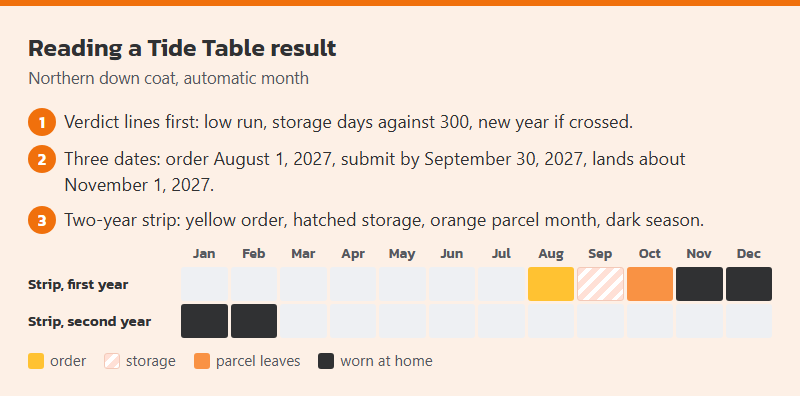
Read the verdict lines first. A yellow strip on the timeline is the order, the hatched run is storage, orange is the month the parcel leaves and dark is your season. Where the plan crosses a new year, an orange edge marks January.
Where the planner’s numbers come from
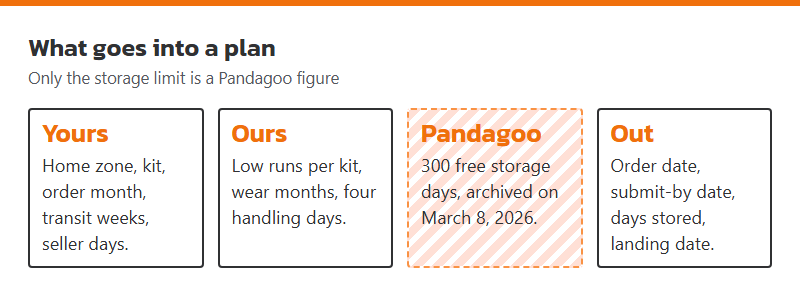
Three kinds of number go in, and only one of them comes from Pandagoo.
- The 300 days are Pandagoo’s archived free-storage promise (archived on March 8, 2026).
- The four handling days are ours. The archive gave an eight-hour window for a manual parcel quote on submissions made between 9am and 4pm Beijing time, 72 hours to pay the freight, and one to two days for the warehouse to send a parcel once paid. Four days covers the usual case.
- The low runs and wear months are our planning assumptions, drawn from how China’s retail seasons turn and from the listings we read. They are not measured prices. Your transit and seller allowances are yours to set.
| Kit | Low run we assume, China’s calendar |
|---|---|
| Down and padded coats | May to August |
| Fleece, knitwear, thermals | April to July |
| Beanies, scarves, gloves | April to August |
| Snow and winter boots | April to August |
| Sandals and slides | October to January |
| Swim shorts and rash tops | October to January |
| Sun jackets, brims, sunglasses | October to February |
| Linen shirts, cotton shorts | September to December |
| Rain shells, trench coats | January and July |
| Watches, rings, bags, gadgets | no low run |
Wear months for a northern home follow the usual cold or warm months there; a southern home uses the same months shifted by half a year. Near the equator the planner gives advice rather than dates, because sun gear never leaves season and warm gear depends on a trip.
Five plans worked through
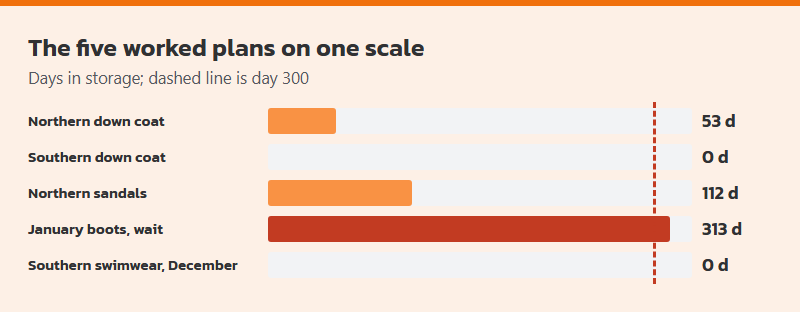
These are the planner’s own answers, run on October 24, 2026 with a four-week line and seven seller days unless noted.
- Northern down coat, automatic month. Order on August 1, 2027, stored about August 8, 2027, submit by September 30, 2027, 53 days in storage, lands around November 1, 2027.
- Southern down coat, automatic month. Order on May 1, 2027 and ship as soon as it is stored; it lands around June 9, 2027, part-way into your winter, with 0 days in storage.
- Northern sandals, automatic month. Order on January 1, 2027, submit by April 30, 2027, 112 days in storage, home around June 1, 2027, the first day of a northern summer.
- Northern boots ordered in January, two-week line, three seller days, landing only before a season. The winter under way is skipped, so the boots wait 313 days and the planner warns that this is 13 days past the free 300.
- Southern swimwear ordered in December, five-week line. Ships at once and lands around January 16, 2027, so the plan crosses the new year and the strip shows the orange January edge.
Want to see which goods fit each plan? The tide shelves group our picks by the same kits, and the equator page explains why the southern plans need no storage at all.