
Path through this catalogue: Low Tide / Costs and freight
Fees and shipping
Bulky winter parcels, light summer ones: costs, rates and freight
Where the money goes on an off-season order, from the archived payment formula to the volume a puffer takes up in a box.
Test the saving after shipping, not before it
Hypothetical comparison in CNY: the same coat costs 180 off season or 220 later. Hold the variant and quantity fixed. The numbers below exclude payment charges and destination charges, which still need checking.
| Scenario | Goods + freight | Result |
|---|---|---|
| Early buy; freight budget 100 | 180 + 100 = 280 | CNY 40 below the later plan if all other costs match. |
| Early buy; final freight 150 | 180 + 150 = 330 | CNY 10 above the later plan. |
| Later buy; freight budget 100 | 220 + 100 = 320 | Comparison baseline, not a future quote. |
A CNY 40 listing saving leaves only CNY 40 for extra freight or other differences before it disappears. Use the price comparison alongside the planner; neither can guarantee future stock, routes or arrival dates.
The payment formula in the archive
Pandagoo did not charge a purchasing service fee on the goods themselves; the archive repeats that promise in several languages. The cost sat in payment handling instead. Its checkout worked out what you paid by adding a fixed US dollar charge to the amount due, then dividing by one minus a percentage. The two values themselves were filled in by the server and were not archived.
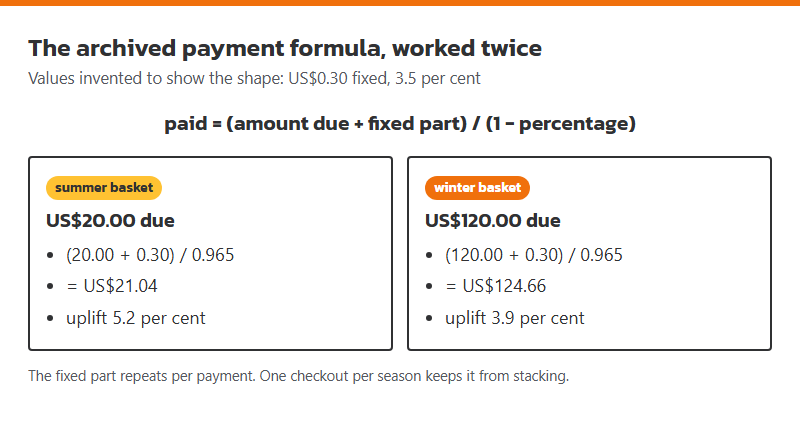
The shape of that formula matters for seasonal buyers. The fixed part is charged per payment, so it weighs most on small baskets. With made-up values of US$0.30 and 3.5 per cent, a US$20.00 summer basket becomes US$21.04, a 5.2 per cent uplift, while a US$120.00 winter basket becomes US$124.66, about 3.9 per cent. Buying one season’s goods in one checkout keeps the fixed part from repeating.
What a puffy parcel is billed at
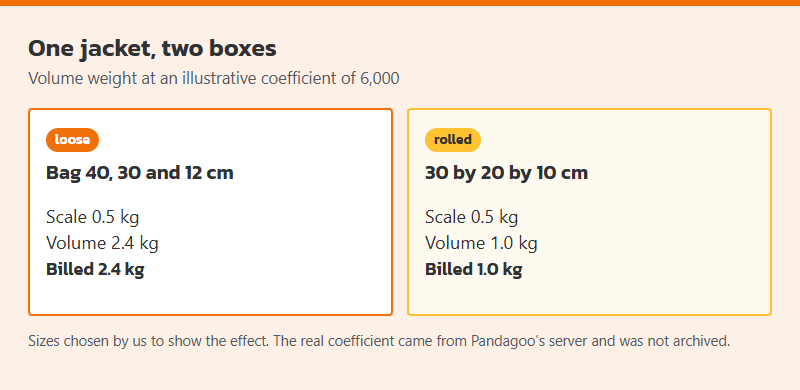
Lines bill whichever figure is heavier, the scale reading or the volume figure. The archive gives the volume rule this way: multiply the box’s three edges in centimetres, divide by the line’s coefficient and multiply by 1,000 to get grams. The coefficient itself came from the server. We use 6,000 below purely as an illustration.
| Packing we chose | Scale weight | Volume weight at 6,000 | Billed at |
|---|---|---|---|
| Down jacket, loose, bag 40 cm long, 30 wide, 12 deep | 0.5 kg | 2.4 kg | 2.4 kg |
| Same jacket rolled into a 30 by 20 by 10 cm pack | 0.5 kg | 1.0 kg | 1.0 kg |
| Sandals in their box, 32 by 22 by 11 cm | 0.7 kg | 1.29 kg | 1.29 kg |
| Sandals bagged without the box | 0.6 kg | well under scale weight | 0.6 kg |
Winter parcels are where volume bites. Ask for coats to be compressed, and drop shoe boxes unless you need them. Summer parcels are usually billed on the scale.
Yuan balance and the rate on deposit day
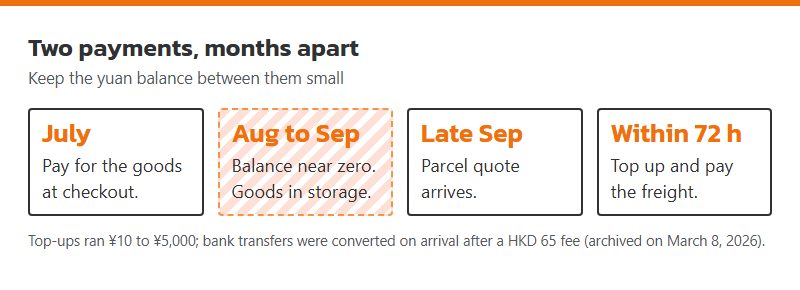
Pandagoo kept balances in yuan. Top-ups ran from ¥10 to ¥5,000 each time, and an overseas bank transfer was converted at the site’s own rate on the day it arrived, two to three working days later, after a fixed HKD 65 receiving-bank fee per transfer. Transfers in yuan from abroad were not accepted. The site’s advice was simply to pick the right currency to avoid a conversion loss; its rate margin was not archived.
Off-season buying stretches the time between paying for goods and paying for freight to several months. Topping up for both at once leaves money sitting in yuan, exposed to the rate. Pay for the goods when you order, and top up for freight only when the parcel quote arrives.
Splitting one season’s buying into two parcels
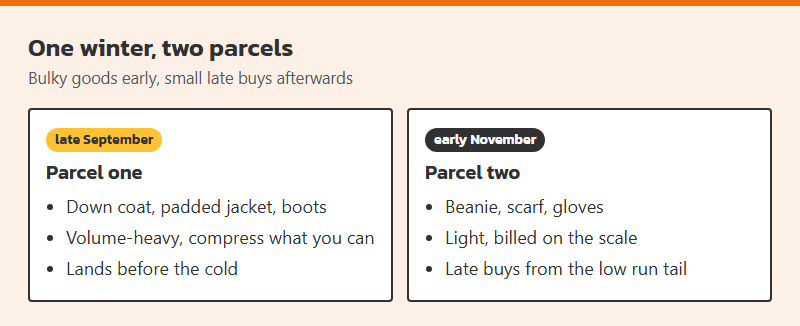
Freight is paid when you submit a parcel, and the archive gave 72 hours to pay before the parcel was cancelled. A northern buyer with winter goods might build one parcel in late September for coats and boots, and a second in early November for hats and gloves bought late. Two parcels cost more in freight than one, but they keep the expensive volume weight of coats away from small items.
Two more archived numbers belong here: the declared value you could enter ranged from 1 to 120 US dollars, and customs rules, the archive said, meant each incoming at the warehouse was opened for a prohibited-items check. Insurance appeared as its own line in the freight total, with no rate archived.
Line choice and your transit weeks
The line list came from the server and none of it was archived: no names, no prices, no transit times. That is why the Tide Table asks you for a transit allowance instead of offering a line. The planner’s four-week input is an illustration, not a validated allowance for your route; replace it with a current estimate and a delay buffer.
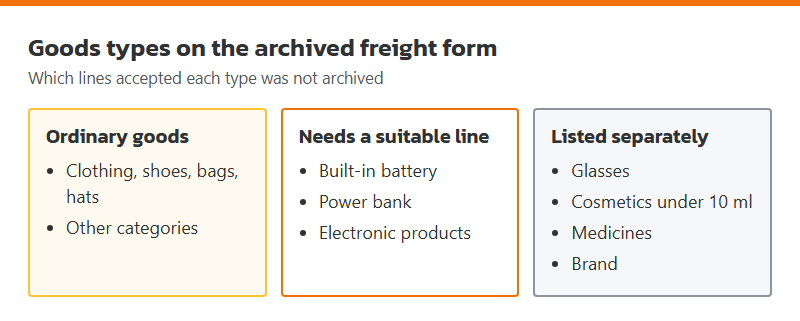
Battery goods need a line that accepts them, and the archived freight form listed built-in battery, power bank and electronic products as separate goods types. Glasses and cosmetics under 10 ml had their own entries as well.
Read next: set your transit allowance in the Tide Table, the order steps.