
Path through this catalogue: Low Tide / Price gap
Price gap
Reading the price gap: clearance, broken size runs and the off-season label
Off-season buying rests on one belief: that a seller in China charges less for a down jacket in July than in November. Sometimes that is true. This page shows what we could and could not see when we read the listings ourselves.
Our 1688 reading from late October
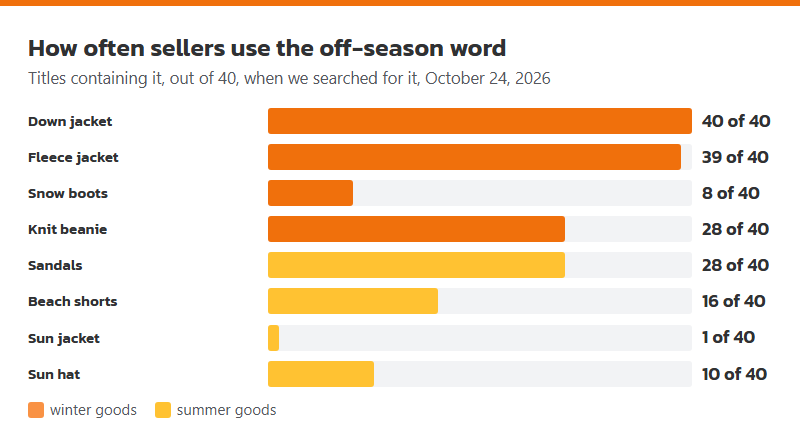
On October 24, 2026, mid-autumn in China, we ran eight seasonal searches on 1688 through an open agent search and kept the first 40 listings of each. For every word we noted the median first-tier price, the median of the monthly sales figure that 1688 prints on each listing, and then ran the same word again with 反季 (literally "against the season") in front of it.
| Search word | Median price, plain search | Median monthly sales | Titles saying 反季, prefixed search | Median price of those titles |
|---|---|---|---|---|
| Down jacket 羽绒服 | ¥116.5 | 107 | 40 of 40 | ¥79 |
| Fleece jacket 摇粒绒外套 | ¥38.5 | 164 | 39 of 40 | ¥80 |
| Snow boots 雪地靴 | ¥27.5 | 255 | 8 of 40 | ¥62.27 |
| Knit beanie 毛线帽 | ¥5.92 | 866 | 28 of 40 | ¥21 |
| Sandals 凉鞋 | ¥23.2 | 136 | 28 of 40 | ¥54.96 |
| Beach shorts 沙滩裤 | ¥10.84 | 183 | 16 of 40 | ¥33 |
| Sun jacket 防晒衣 | ¥22.32 | 94 | 1 of 40 | ¥51.33 |
| Sun hat 遮阳帽 | ¥7.35 | 1033 | 10 of 40 | ¥11 |
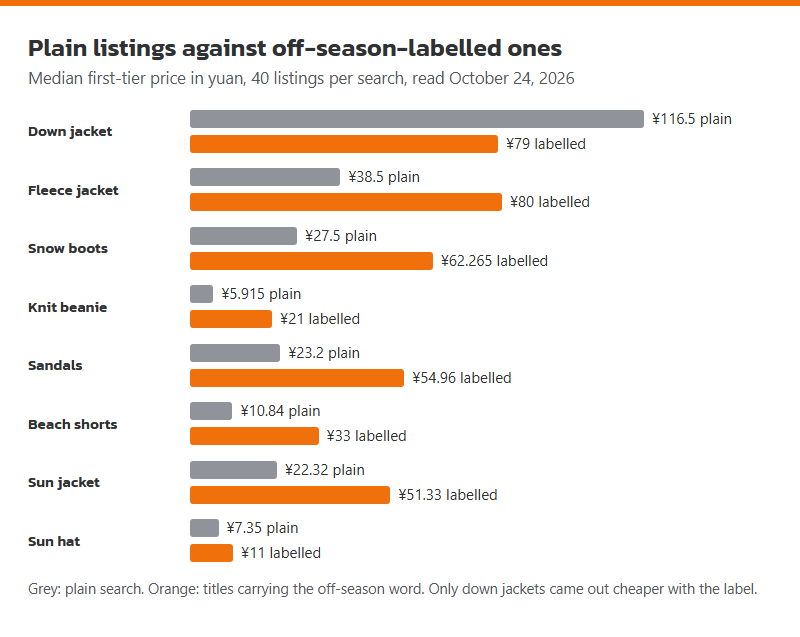
Two things stood out. In the plain searches, not one of the 320 titles used the off-season word: in late October nobody needs it for winter goods, and summer goods were simply listed as summer goods. And the listings that do carry the word were usually dearer, not cheaper. Only down jackets went the way the theory says, at a median of ¥79 against ¥116.5.
Monthly sales did not split along the seasons either. Sun hats showed a median of 1,033 sold in the past month and beach shorts 183, in October. 1688 is a wholesale market: some of those buyers ship to Southeast Asia, where shorts never go out of season, and some to the southern half of the world, where October is spring.
Why a seller drops a price out of season
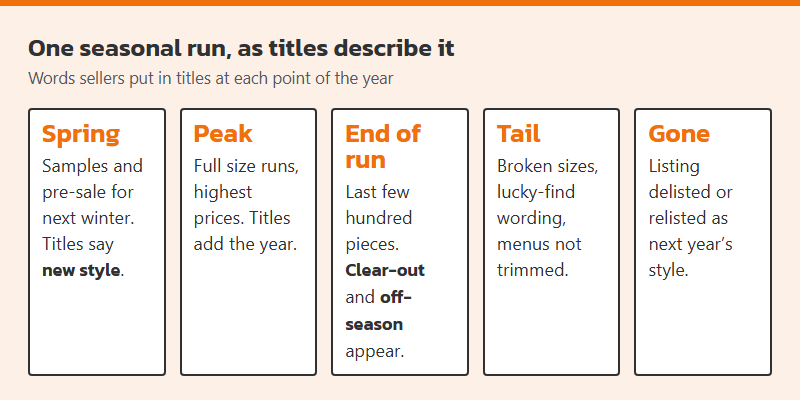
The reasons are ordinary ones. A shop that made 3,000 padded jackets for winter has to clear the last few hundred before its space and cash go into spring stock. A factory in Pinghu, the down-garment town that shows up again and again in 1688 titles, runs next winter’s samples in early summer and sells the end of the old run cheaply to make room. Retail shops on Taobao follow the same rhythm a little later, because they buy from those factories.
What we cannot tell you is how big the gap is. Nobody publishes a price history for a 1688 listing, and one reading in October is a snapshot, not a curve. Where this site says "cheaper in the low months", read it as a pattern worth testing, and test it with the method in the next sections.
When the off-season label costs more
The off-season word is a sales tag, and in our reading it sat mostly on heavier, better-specified goods. The fleece results were full of titles such as 反季清货!620克双面摇粒绒, which reads "off-season clear-out, 620 g double-sided fleece": a much heavier cloth than the plain-search fleece at a median of ¥38.5. The snow-boot results leaned toward real leather with a wool lining. Those are good buys at their price; they are not cheap versions of the plain listing.
So the label tells you a shop is clearing stock. It does not tell you the price is lower than the same item from a shop that never used the word. Compare like with like: same fabric weight, same fill, same sole, then look at price.
Tracking one listing across months
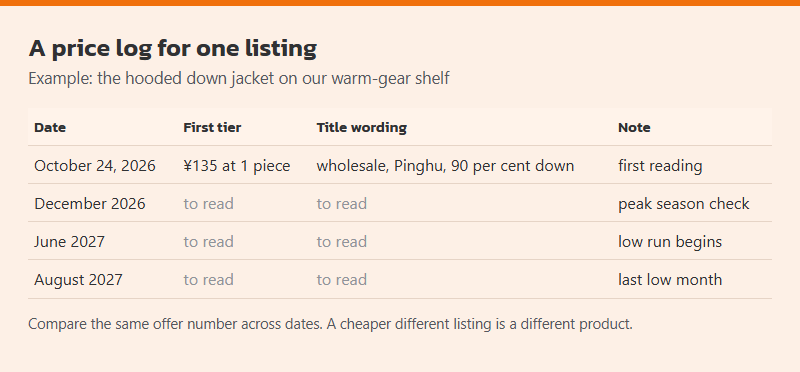
The only honest way to see a price gap is to watch one listing. Keep a short log for each item you are thinking about:
- Copy the 1688 offer number (the long figure in the address) and the first price tier with its minimum quantity.
- Write down the date and whether the title says new season, clearance or broken sizes.
- Read it again six to eight weeks later, and once more when the low months begin.
- Only then compare. A different listing at a lower price is a different product until proven otherwise.
Each card on our tide shelves shows the offer number and the first tier we read on October 24, so you already have the first entry of that log for every pick.
Broken size runs and last year’s colours
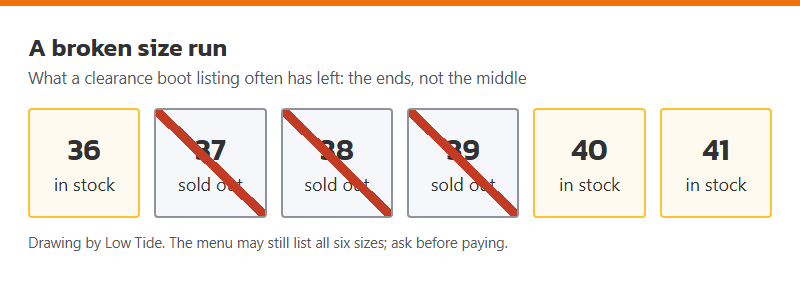
Two Chinese words explain most real clearance prices. 断码 means a broken size run: the shop still has 36 and 40 but no 37 to 39. 捡漏 means a lucky find, a bargain for whoever happens to fit. One snow-boot title in our reading carried both. If your size is in the middle of the range, clearance stock is often exactly where you will not find it.
Colour works the same way. Last winter’s colour menu may still show five shades while only two are in stock; the menu is rarely trimmed. Ask the seller, or let the agent ask, before you pay, and read our notes on picking off-season stock for what to write in the order remarks.
Read next: which side of the equator gets the gap for free, the Tide Table planner.